PREVIEW MODULE 2
Diabetes distress
This module is designed to support conversations around diabetes distress in real clinical settings.
It helps patients recognise what they are feeling, and gives clinicians a simple way to open conversations that are often difficult to start.
Preview – Diabetes distress
This preview introduces the visual approach by showing the emotional landscape of diabetes distress and how it can be used to open conversations in a clinical setting. The full module builds on this with additional layers designed for use in practice, including narrative comic scenarios that reflect real patient experiences and a set of practical tools to support those conversations and help patients respond in manageable ways. It can be used during a consultation, shared with patients, or explored independently alongside routine care. After using the sample, you may begin to see how patients respond to the visuals and how this approach fits within your workflow, with the option to explore additional modules if it feels useful. Early feedback helps ensure the work remains grounded in real clinical settings, and a short follow-up will capture how it was used and how patients responded, designed to be quick and low effort.
Conversation tools for diabetes distress
The following visuals introduce the emotional landscape of diabetes distress.
The full module includes practical tools to support these conversations in real time.
A4 Visual Guide (15 pages)
Presentation Slides (15 slides)
The A4 Visual Guide is designed to print and use with patients. The Presentation Slides are for screen use in consultations or group sessions.
Educator Guide
HOW TO USE IT
Use the visuals during:
The visual tools are designed to:
How to use the visuals
FACILITATION GUIDE
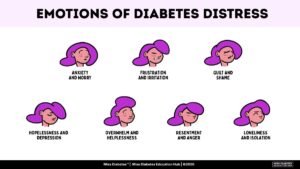
SLIDE 1 – The Emotional Landscape of Diabetes Distress
This slide works as a conversation starter and shows the seven emotional territories of diabetes distress: Anxiety & Worry / Frustration & Irritation / Guilt & Shame / Hopelessness & Depression / Overwhelm & Helplessness / Resentment & Anger / Loneliness & Isolation
Ask “Which of these feels most familiar to you right now?” Your patient’s answer guides the rest of the session. If they are unable to identify the emotion they are feeling, you can use the slides 2-7 which expand on each emotional territory with examples.
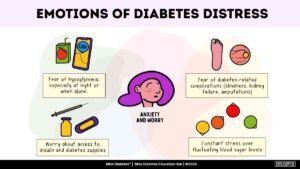
SLIDE 2 – Anxiety and worry
Anxiety and fear of hypoglycaemia are the most clinically documented forms of diabetes distress. They can be directly measured by PAID-5 items 1 and 2. Examples of anxiety worry are shown on the slide:
-Fear of hypoglycaemia, especially at night or when alone
-Fear of diabetes-related complications
-Worry about access to insulin and/or diabetes supplies
-Constant stress over fluctuating blood glucose levels
Ask “What particular things are making you feel anxious right now?” Your patient’s answer guides the rest of the session.
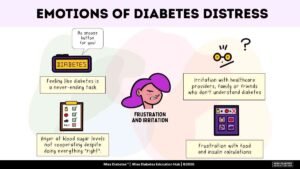
SLIDE 3 – Frustration and irritation
The “doing everything right and still getting high glucose” results is still one of the most universal and under-validated distress experiences in diabetes. This is regimen-related distress, which can be directly measured by the DDS subscale. Examples of frustration and irritation are shown on the slide:
-Feeling like diabetes is a never-ending task
-Irritation with healthcare providers, family or friends who don’t understand
-Anger at blood sugar levels not cooperating despite doing everything right
-Frustration with food and insulin calculations.
Ask “What is making you frustrated or irritated right now?” Your patient’s answer guides the rest of the session.
Access more in the full module
What this module is aligned to
CLINICAL ALIGNMENT
NICE NG17 — Psychological wellbeing
Aligned with National Institute for Health and Care Excellence (NG17) guidance to support psychological wellbeing and identify factors affecting self management in people with type 1 diabetes.
ADA Standards of Care — Psychosocial Care
Aligned with American Diabetes Association Standards of Care recommendations to screen for diabetes distress and address psychosocial factors impacting diabetes management.
Diabetes Distress Scale (DDS) / PAID
Informed by validated measures including the Diabetes Distress Scale (DDS) and Problem Areas in Diabetes (PAID), supporting recognition of emotional burden in clinical practice.
ISPAD — Psychological care in diabetes
Aligned with ISPAD guidelines recommending routine assessment and discussion of psychosocial wellbeing as part of diabetes care.
Interested in trying out the whole diabetes distress module?
If the module feels like a good fit, please express your interest to become a pilot partner, to get access to the full diabetes distress module. This includes the complete set of visual conversation tools, narrative comic scenarios that reflect real patient experiences, and practical tools designed to support conversations and ongoing self-management. You’ll also receive the full educator guide with step-by-step guidance for use in consultations, along with clinical alignment documentation and optional outcome measurement.
The full module also includes a companion narrative for patients, using visual storytelling to reflect real experiences of diabetes and extend the conversation beyond the consultation. It helps patients feel understood, less alone, and more able to process what they are going through..
As a pilot partner, you’ll be using the module within your own setting, with the opportunity to shape how it develops through real-world use. Feedback from your team will be used to refine the content, improve how it fits into clinical workflows, and ensure the modules remain grounded in both lived experience and practice.